Issues in healthcare, such as staff shortages and an aging population, call for solutions in the areas of efficiency and labor-saving innovations. FMed regularly gives a voice to affiliated companies that are actively working on developments that contribute to this.
This time: Cablon Medical. This FMed member developed CNERGY Go!: patient identification using a biometric palm scan. This ensures that patients are never mixed up and saves time. Safe and efficient.
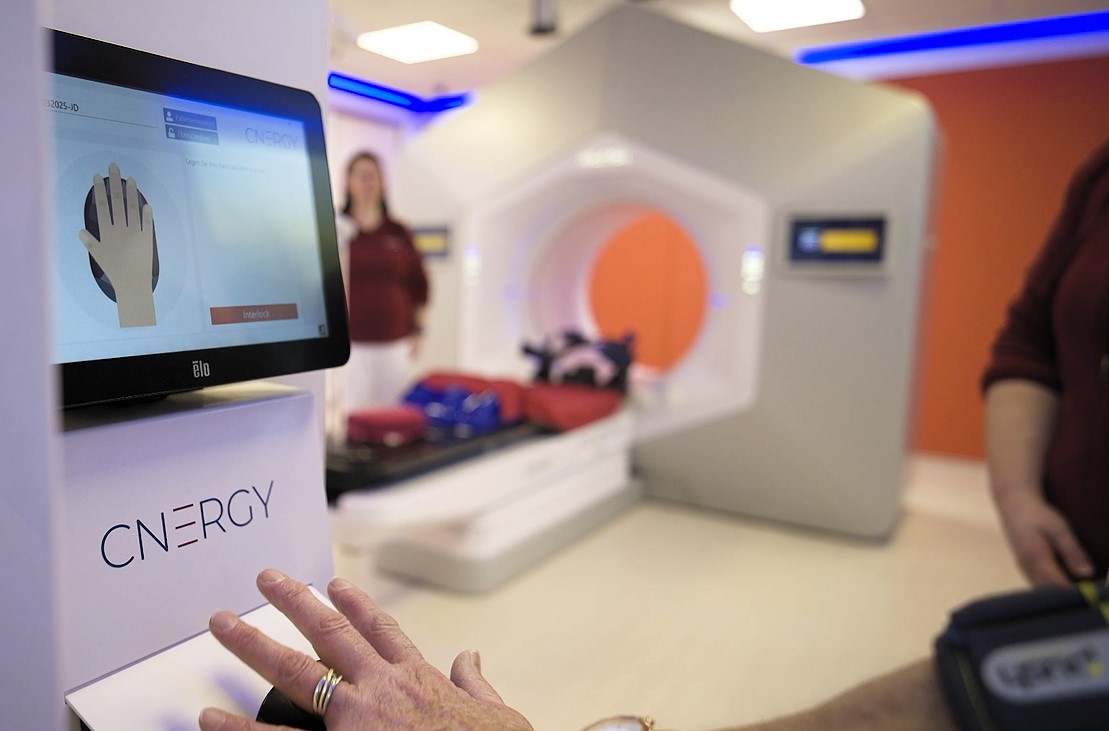
CNERGY Go! is actually very simple, says Jurjen Weistra of Cablon Medical, a manufacturer of medical devices and developer of software and hardware for radiotherapy treatments and radiological imaging. During the first appointment at the radiotherapy department, both of the patient’s hands are scanned. The structure of the bloodlines in the hand is unique to each patient, and even more unique than a fingerprint. This structure is stored as an encrypted code linked to the patient.
Each subsequent time the patient visits the department, they scan their hand at the check-in kiosk. This scan takes half a second. The patient then receives information about the correct waiting room or treatment room, and the staff knows that the patient has arrived. In the treatment room, the hand is scanned again for verification, to ensure that the right patient receives the right treatment. The correct accessories are also linked to the hand scan. “The area to be irradiated is often very small and must be irradiated with great precision,” explains Weistra. “The position of the patient on the treatment table is therefore extremely important. The accessories, such as cushions, must be positioned exactly right.”
Forty minutes of time saved
Working with CNERGY Go! ensures highly reliable patient identification, says Weistra. “Unfortunately, it still happens that patients are mixed up. In radiotherapy, it is disastrous if patient identification goes wrong, because you don’t want the wrong patient to be irradiated with another patient’s treatment plan, causing healthy tissue to be affected by the radiation.”
Until now, patient identification has often been done by providing the patient’s name and date of birth, but this system is not foolproof. Fingerprints are not 100% reliable either, as they can disappear as a result of chemotherapy, which is often used in combination with radiation therapy. Wristbands or ID cards do not always work either and are not biometrically linked to the patient. CNERGY Go!, on the other hand, is completely secure, according to Weistra.
Another goal of Cablon Medical is to save labor. Weistra estimates that CNERGY Go! saves about half a minute per radiotherapy treatment. Depending on regional differences, each radiotherapy machine often sees between 40 and 80 patients per day. Abroad, treatment often takes place from 7 a.m. to 10 p.m., while in the Netherlands it is usually from 8 a.m. to 5 p.m. This means a daily saving of up to 40 minutes. This allows more patients to be treated. With the new working method, the radiotherapy department can also choose to give patients more time and attention during treatment. “The time you save at the beginning and end of treatment can be given to the patient when they really need it.”
Airports
The palm scan technology is not entirely new and is already being used in other sectors, such as banking and airport access. However, Cablon Medical has now fully integrated the technology into the hospital’s radiation system. Around 25 locations in Europe are already using it, and it has been put into clinical use for the first time in the Benelux in 2024. In addition to radiotherapy departments, the company is now focusing (together with its sister company Diasoft) on dialysis departments. After all, dialysis patients also return to the hospital regularly for treatment.
And what do patients themselves think of it? They are very enthusiastic, says Weistra. “Patients like being anonymous and usually find our system very easy to use. Even older patients often find it a piece of cake.”
This message has been translated from Dutch into English. You can read the original interview here.